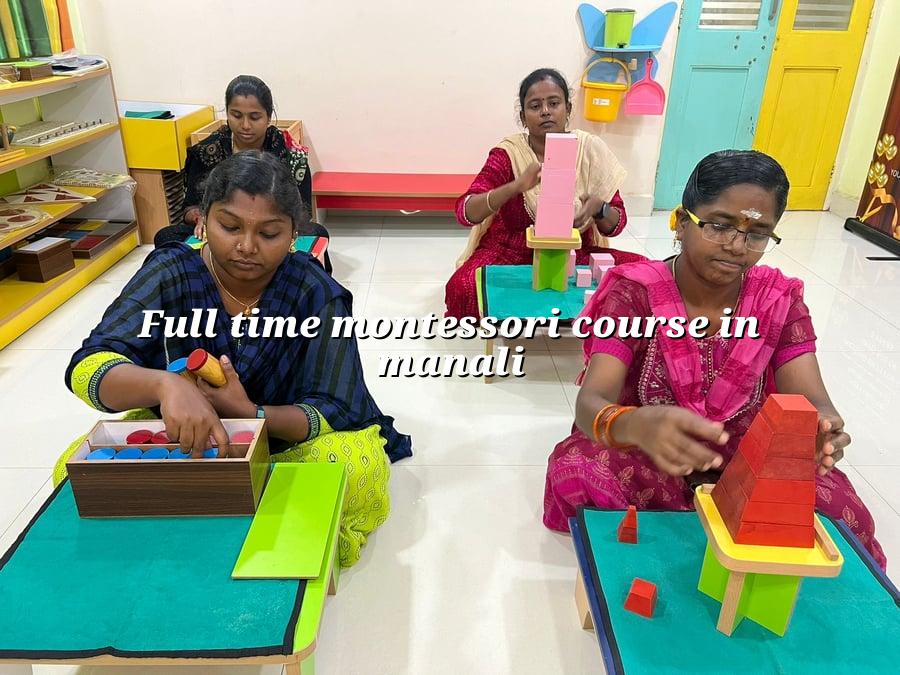
A full time Montessori course in Manali should give you more than theory, and this page shows exactly what to look for before you enrol. If you are planning a serious start in Montessori teaching, you will see how a full-day schedule, guided material work and classroom practice shape real confidence.
This guide is for students and career changers in and around Chennai who want a structured path into early childhood education. It covers training focus, daily learning rhythm, what practical exposure should include, and how a Montessori teacher training program can support your next step with placement assistance and ongoing mentoring.
When someone searches for a full time Montessori course in Manali, the real intent is usually simple: they want a complete training experience with steady practice, not a rushed certificate. A strong program should balance Montessori philosophy, child development, classroom observation, and hands-on material work so that you can step into a preschool or Montessori house with confidence. For learners in Chennai, especially those considering the Manali area and nearby neighbourhoods, the right course should also fit around travel, batch timing and long-term career goals.
A full-time format helps you stay immersed in the methods that Montessori teaching depends on. Instead of studying in scattered short sessions, you revisit practical life, sensorial, language, mathematics and cultural work in a regular rhythm, which makes the pedagogy easier to absorb. This matters when you are learning how to present materials, observe a child’s readiness, and adapt lessons without losing the calm, ordered style that Montessori classrooms require.
Most prospective students want to know whether the training is classroom-focused, whether they will handle real Montessori materials, and whether the institute supports careers after completion. A credible Montessori teacher training path should also feel relevant to Chennai schools, where parents and educators value both authentic method and practical classroom readiness. If you are comparing options, a full-day course often works best when it includes guided practice, internships, and a clear route to further support through our courses or the online program for flexible learning needs.
| Training Element | What You Learn | Why It Matters |
|---|---|---|
| Practical Life | Care of self, care of environment and grace and courtesy routines | Builds order, independence and classroom discipline |
| Sensorial Work | Material presentations that refine movement, sight, touch and comparison skills | Helps children organise sensory impressions and think clearly |
| Language and Mathematics | Phonics, vocabulary, reading readiness, number work and simple operations | Supports school readiness and age-appropriate progression |
| Observation and Practice | Watching children, presenting materials and receiving guided feedback | Turns theory into classroom confidence and better lesson delivery |
A full-time format suits learners who want a disciplined routine and deeper practice before stepping into teaching roles. It is a good fit if you are a recent school graduate exploring early childhood education, a homemaker returning to work, or a preschool assistant who wants formal Montessori training. It also suits people who learn best through repetition, live demonstrations and direct feedback.
For Manali and nearby Chennai neighbourhoods, the practical question is often commute and time management. A full-time course works best when the institute provides a clear schedule, a supportive learning environment and access to hands-on resources, so you can focus on skill-building instead of piecing together scattered notes from different sources. If you prefer a blended approach, you can also compare it with practical workshops or a longer internship path through internship training.
One common mistake is choosing a course only because the title sounds convenient. A Montessori program should not be judged by name alone; you need to see whether it offers real classroom practice, child-development grounding and clear guidance on how to apply the method. Another mistake is assuming that online videos are enough for material-based teaching, when the method depends on real handling, repetition and supervised correction.
In a good program, the day has a rhythm. You listen, observe, practise, correct and repeat. That rhythm is exactly why many learners feel more ready after a full-time Montessori course in Manali than after a short, theory-heavy option. It creates the habits you need to speak calmly, present clearly and respect the child’s pace.
Before your first class, it helps to read about the Montessori environment, child-sized learning tools and the role of the teacher as a guide. Bring a notebook, stay open to feedback and be ready to practise the same presentation more than once until it feels natural. The method rewards patience, neatness and observation, so the habits you build during training matter as much as the content itself.
Students from areas like Kolathur, Anna Nagar, Velachery, Tambaram, Porur and Medavakkam often want a course that respects their time while still giving complete exposure. That is why a well-designed full-time course should feel structured, supportive and practical from the first week. If you want to explore the institute and learning environment, you can also browse the gallery or read student experiences on testimonials.
Super Star Montessori offers authentic Montessori teacher training with practical sessions, guided material work, and career support from an experienced Chennai-based institute. If you are considering a full time Montessori course in Manali, our Montessori, Nursery (NTT), Kindergarten (KTT), Online and Internship training options can help you choose the learning mode that fits your schedule and goals. You can begin with a counselling call, compare the course pathways and move ahead with a clearer plan for your teaching career.
Call +91 90924 63091 or +91 86680 47390, email info@superstarmontessori.com, or chat on WhatsApp.
A full-time course usually includes Montessori philosophy, child development, practical life, sensorial, language, mathematics and cultural work. At a strong institute, you should also find guided material presentations, observation practice and support for applying the method in real classrooms.
It depends on your learning style and schedule, but full-time training is often better for learners who want deeper immersion and faster classroom confidence. Because the sessions are more regular, you can build routine, repeat presentations and absorb the method more naturally.
Yes, many learners choose programs based on commute convenience and batch timing. If you are in Chennai or nearby areas, it is sensible to check the campus location, schedule and practical exposure before enrolling so the course fits your daily travel.
Practical experience is one of the most important parts of Montessori training. A reliable course should include material handling, lesson presentations, observation work and opportunities to understand how a Montessori environment runs day to day.
Graduates commonly move into preschool, kindergarten and Montessori classroom roles, and some later choose further study or specialise in early childhood education. Career support, internship exposure and mentoring can make the transition smoother when you begin your job search.
Look for clear course structure, hands-on training, experienced guidance and support after the course. It also helps to review the institute’s gallery, testimonials and course options so you can judge the learning environment before you join.