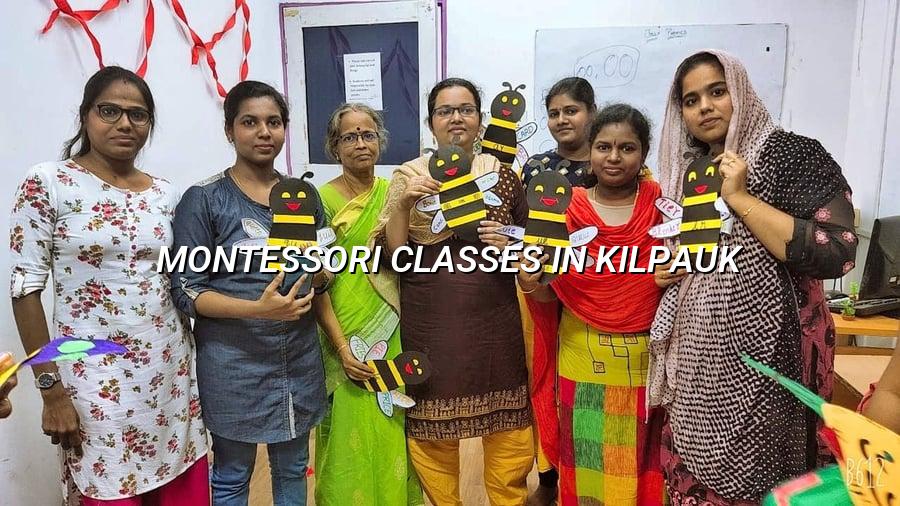
Montessori classes in Kilpauk should help a child build focus, independence, language, and confidence through real hands-on work. If you are comparing options nearby, this page shows what quality Montessori learning should look like and how to judge it with confidence.
Families in Kilpauk often want a classroom that feels calm, child-centred, and practical rather than crowded with worksheets. Here you will find a clear overview of the Montessori approach, the age-wise classroom pattern, and the everyday learning habits that matter most for early childhood growth in Chennai.
When parents search for Montessori classes in Kilpauk, they are usually looking for more than a school building. They want teachers who understand child development, materials that invite independent work, and a routine that supports practical life, sensorial learning, language, mathematics, and cultural awareness. A strong Montessori environment also respects the child’s pace, so learning feels active rather than pressured.
In a genuine Montessori setting, shelves are organised, materials are reachable, and each activity has a clear purpose. A child may begin with pouring, buttoning, or sorting objects before moving to sandpaper letters, phonetic language work, and number rods. That sequence builds concentration and coordination in a way that suits preschool and early primary years, especially for families in Kilpauk, Anna Nagar, Chetpet, and nearby Chennai neighbourhoods.
Watch how teachers speak to children, how movement is managed, and whether the environment gives children space to choose work with guidance. The best classrooms do not feel noisy or overfilled; they feel purposeful. If a centre claims Montessori methods but relies mainly on worksheets and whole-class repetition, it is worth asking deeper questions before enrolling.
| Learning Area | What Children Do | Why It Helps |
|---|---|---|
| Practical Life | Pouring, dressing frames, washing, sorting, and table care | Builds concentration, coordination, and independence |
| Sensorial | Matching, grading, comparing size, shape, colour, and texture | Sharpens observation and prepares the mind for later concepts |
| Language | Sound work, vocabulary, storytelling, early reading, and writing preparation | Supports clear expression and strong phonemic awareness |
| Mathematics | Counting materials, quantity work, numeral association, and sequencing | Makes abstract ideas concrete and easier to understand |
For many families in Kilpauk and nearby areas such as Nungambakkam, Chetpet, Anna Nagar, and Purasawalkam, the biggest value of Montessori classes is consistency. Children learn how to choose work, complete a task, return materials, and move with care through the room. Those habits often show up at home too, where dressing, tidying, and following simple routines become easier.
Montessori learning also supports children who need more time to settle into a classroom. Because the method uses repetition, touch, and observation, a teacher can notice exactly where a child is strong and where support is needed. That is especially useful in the early years, when language development, social comfort, and hand control are all growing together.
Parents should also think beyond the first classroom experience. A solid early foundation can prepare a child for more confident transitions into higher preschool levels, kindergarten, and eventually primary learning. The best Montessori classes in Kilpauk are the ones that help children feel secure while steadily building skill.
In a quality environment, teachers do not dominate every minute. They observe, present materials one child or small group at a time, and step back so children can work independently. This style matters because Montessori is not only about materials; it is about how adults respect the child’s effort and help without taking over.
Children learn through repetition, so the same material may be used many times in slightly different ways. That repetition is not a sign of boredom; it is part of mastery. A child who pours water carefully, traces a letter shape, or counts beads with focus is practising control, memory, and accuracy at the same time.
If you are comparing Montessori classes in Kilpauk from a parent’s point of view, our Chennai campus can help you understand the method from both the child and teacher perspectives. We offer authentic Montessori Teacher Training, Nursery Teacher Training, Kindergarten Teacher Training, Online Montessori Course, and practical workshops that explain how real classroom work is planned and delivered. You can also explore our courses or the online program to see which learning mode fits your schedule best.
Call +91 90924 63091 or +91 86680 47390, email info@superstarmontessori.com, or chat on WhatsApp.
Look for a calm classroom, accessible materials, and teachers who can explain the purpose of each activity. A genuine Montessori setup should support independence, practical life work, and hands-on learning instead of relying mainly on worksheets. It should also feel organised and child-friendly during your visit.
Yes, Montessori learning is often a strong fit for preschool years because it builds concentration, language, and fine motor control in a gradual way. Children learn by handling materials, repeating activities, and developing independence in daily routines. That structure is useful for families who want a steady, child-centred start.
Ask how teachers present work, how children choose activities, and whether the classroom includes practical life, sensorial, language, and math materials. If the program is mostly teacher-led with constant worksheets, it may only use the Montessori name loosely. Observation during a visit usually tells you a lot.
They can, because Montessori language work begins with sound awareness, vocabulary building, and tactile letter activities. Children often move from listening and tracing to matching sounds and later to reading readiness at their own pace. The approach makes early literacy feel concrete rather than rushed.
Yes, you can speak with the institute to understand teacher training options, classroom practice, and the difference between Montessori, NTT, and KTT pathways. That helps if you are a parent, aspiring teacher, or school owner exploring early childhood education in Chennai. A short counselling call can make the decision much clearer.
Start by learning the Montessori philosophy, then observe how children work with materials in a practical classroom. If possible, review the curriculum areas and ask about training mode, internship support, and teaching practice. That background makes the first training sessions far more meaningful.