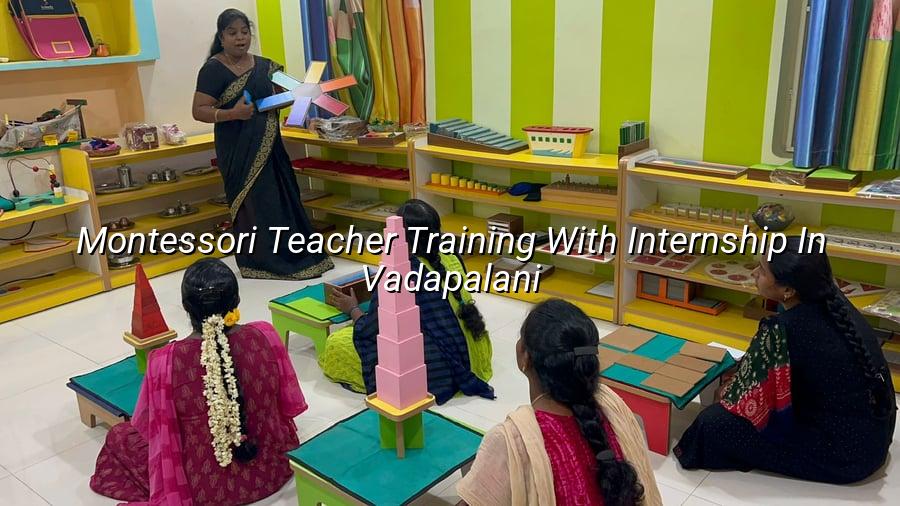
Montessori teacher training with internship Vadapalani gives you the rare mix of theory, observation and real classroom practice that employers value most. If you want to step into early childhood education with confidence, this page shows how internship-led learning builds the habits, language and material-handling skills needed in a real Montessori setting.
This guide is for aspiring teachers in Vadapalani and nearby Chennai neighbourhoods who want practical training instead of classroom theory alone. You will see how internship exposure fits into Montessori learning, what to expect from a structured training pathway, and how it can support your preparation for roles in preschools, kindergarten classrooms and Montessori houses.
Parents and school owners may appreciate a certificate, but classrooms run on practical skill. A strong Montessori teacher learns how to prepare the environment, present materials, observe the child, maintain order, and guide learning without interrupting concentration. Internship training makes those habits visible and repeatable, which is especially useful when you are starting out and need real classroom rhythm rather than only lecture notes.
For learners around Vadapalani, Anna Nagar, Koyambedu, Kodambakkam and nearby parts of Chennai, internship exposure can bridge the gap between course work and day-to-day teaching. It helps you understand how children respond to practical life, sensorial, language, mathematics and cultural activities, while also showing how a lead teacher manages routines, transitions and parent communication.
During internship training, you do more than observe from the back of the room. You may watch classroom setup, learn how materials are introduced, support children during independent work, and practise simple routines such as handling spills, guiding line-walking, or helping with classroom discipline in a calm Montessori way. These experiences matter because Montessori teaching depends on precision, patience and respectful communication, not just subject knowledge.
Many first-time trainees assume they can become classroom-ready by studying manuals alone. The reality is different: children behave differently across age groups, schools, and schedules, so you need real interaction to build confidence. Internship experience lets you see how a classroom responds on a busy weekday, how materials are rotated, and how a trainer adapts to children who need more encouragement, movement or repetition.
| Training Focus | Best For | Practical Outcome |
|---|---|---|
| Diploma in Montessori Teacher Training | Beginners who want full Montessori preparation | Strong foundation in pedagogy, materials and classroom routines |
| Nursery Teacher Training | Those aiming for nursery and preschool roles | Early childhood classroom basics with child-centric activity practice |
| Kindergarten Teacher Training | Teachers focused on LKG and UKG classrooms | Age-appropriate lesson planning, storytelling and activity handling |
| Montessori Teacher Training with Internship | Learners who want live classroom exposure | Observation, guided practice and confidence in real teaching situations |
A useful internship is not random observation time. It should be structured so that you can see the flow of the classroom, understand how a teacher prepares materials, and notice how children move from one activity to another without losing focus. In an authentic Montessori environment, even small actions matter: how you roll a mat, carry a tray, speak at child level, or wait for the child to respond before stepping in.
In Chennai, especially for learners in and around Vadapalani, this kind of practical exposure matters because many schools expect new teachers to be classroom-ready quickly. That means your training should include guided practice, feedback from trainers, and repeated exposure to real teaching scenarios so that you are not learning every classroom habit for the first time after joining a school.
One common mistake is focusing only on theory terms and ignoring the sequence of classroom work. Another is speaking too much during observation instead of quietly studying the environment, child behaviour and teacher-child interaction. Some trainees also underestimate the value of material familiarity; if you do not practise with the actual Montessori apparatus, it becomes harder to present lessons confidently when you are standing in front of children.
Confidence grows when you repeat the same task in different classroom moments. After a few cycles of observation and practice, you begin to notice patterns: when children are most attentive, how to redirect energy without scolding, and how to support independence with the least possible interruption. That change is often what separates a hesitant beginner from a dependable classroom assistant or trainee teacher.
Preparation begins before the internship starts. If you arrive with an understanding of the Montessori method, you will absorb classroom routines faster and ask better questions during the practice phase. The goal is to enter the internship ready to observe, reflect and apply, not just to complete attendance.
It also helps to keep notes after each observation session. Write down how the teacher introduced the material, how children reacted, what language was used, and what classroom management choices worked well. These small reflections can become valuable revision points when you revisit your training later.
Super Star Montessori Teacher Training Institute offers practical Montessori, NTT and KTT learning designed to help you move from theory to classroom readiness. If you want internship exposure, guided material work and a training pathway that supports your teaching career in Chennai, you can also explore our courses, internship training program or the online program depending on your schedule. The focus is always on authentic pedagogy, supervised practice and long-term career support.
Call +91 90924 63091 or +91 86680 47390, email info@superstarmontessori.com, or chat on WhatsApp.
Yes, learners from Vadapalani can choose Montessori training that includes internship exposure in Chennai. The practical component is useful because it lets you see how a real classroom works, rather than learning only from theory notes. If you are comparing options, ask whether the internship includes guided observation and supervised participation.
During a Montessori internship, you usually observe classroom routines, learn material presentation, support children during independent work and understand how teachers manage behaviour gently. You may also note lesson flow, language use and the arrangement of the prepared environment. The exact tasks depend on the training plan and the stage of your course.
The duration depends on the program you choose. A diploma route is often more comprehensive, while shorter NTT or KTT options can suit learners who want a faster entry into preschool teaching. The internship phase should be long enough to give you repeated classroom exposure and not just a one-day visit.
Yes, it helps you speak about real classroom situations instead of only describing theory. Interviewers often look for confidence in lesson presentation, child handling and classroom awareness, and internship experience gives you examples to discuss. It also shows that you have spent time in a live learning environment.
Many learners across Chennai choose a campus or training schedule that fits their travel pattern. If you are commuting from Anna Nagar, Porur or nearby areas, check weekday, weekend or hybrid options so that your attendance stays consistent. A stable routine helps you follow both the theory and internship parts without unnecessary gaps.
It helps to learn basic Montessori terminology, child observation methods and simple material handling before internship begins. You should also practise calm speaking, patience and careful listening, because these habits matter in every classroom interaction. The more prepared you are, the more useful your internship experience becomes.