An offline Montessori course in Guduvanchery gives you the confidence to learn child-centered teaching through real classroom practice, not just theory. If you want to work with young learners in Chennai or nearby growth corridors, this path helps you build practical skills, observe authentic Montessori methods and prepare for a meaningful teaching role.
This page is for aspiring teachers, parents, and career changers who want a clear, local path into Montessori education. You will see what an offline program includes, how training usually progresses, which classroom skills matter most, and how Super Star Montessori supports learners from Guduvanchery, Chromepet, Tambaram and the wider Chennai belt.
A strong offline Montessori course in Guduvanchery should do more than introduce the Montessori name. It should train you in practical life activities, sensorial work, language support, early mathematics, classroom routines and the respectful way an adult guides a child. In a good offline setting, you practice with materials, ask questions in real time and learn how a prepared environment changes the way children respond.
Montessori teaching depends on precision. Handling pink tower pieces, pouring exercises, spooning work or sandpaper letters on a screen is not the same as doing them on a table with proper guidance. Offline sessions let you correct your movement, observe demonstration lessons closely and understand how a trainer introduces each material step by step. That makes the learning more natural when you later teach in a preschool, kindergarten or Montessori house.
This training works well for fresh graduates, homemakers returning to work, school assistants, preschool teachers and anyone in Guduvanchery or surrounding areas who wants a classroom-based course with structure. If you live near Tambaram, Pallavaram, Chromepet or the OMR side of Chennai, an offline format can feel especially practical because you can stay focused, attend regular sessions and build confidence through repeated hands-on practice.
| Training Element | What You Learn | Why It Helps |
|---|---|---|
| Material Demonstration | How to present Montessori tools with clear movement and language | Builds confidence before you teach children |
| Observation Sessions | How children choose work, repeat activities and stay engaged | Helps you understand child-led learning |
| Lesson Practice | Short teaching presentations with trainer feedback | Improves classroom delivery and timing |
| Career Support | Resume guidance, interview prep and placement assistance | Supports your move into preschool or Montessori roles |
An offline Montessori classroom teaches more than subject content; it trains your eye, hand and voice. You learn how to place materials neatly, when to step back, how to offer a lesson once and let the child work independently, and how to keep the environment calm and orderly. These habits matter in Chennai schools where parents look for teachers who are patient, clear and truly familiar with Montessori practice.
For many learners, the biggest shift is understanding that the adult is a guide, not the center of the room. Instead of overexplaining, you demonstrate, observe and support. That approach is especially useful if you plan to teach younger groups in a preschool or kindergarten setting, where children benefit from repetition, movement and carefully prepared activities.
A common mistake is choosing a course that sounds Montessori but does not provide enough hands-on work. If you only hear about theory, certification or child psychology, you may miss the practical sequence that makes Montessori effective. Ask whether the program includes live material demonstrations, classroom observation, teaching practice and feedback on your presentations before you enroll.
In a well-run batch, you should expect regular practice, clear sequencing and room to ask questions. Trainers may demonstrate a work, let you repeat it, correct your posture or wording, and then show how the same lesson changes for different age groups. That kind of repetition helps you remember what to do when you later stand in front of a real classroom in Guduvanchery or anywhere in Chennai.
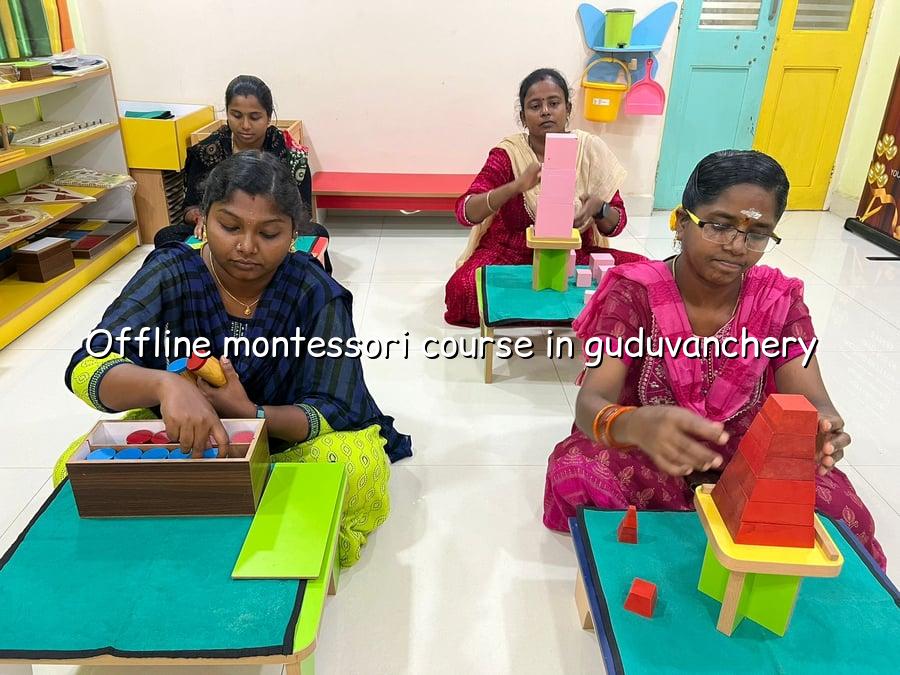
Some learners want a full Montessori diploma, while others are looking for a shorter nursery teacher training or kindergarten teacher training route. If your goal is to start teaching in a preschool soon, a structured offline program can help you gain classroom readiness faster because you spend more time practicing directly with materials and guidance. If you are balancing work or family responsibilities, you can still ask about weekday, weekend, hybrid or online support while keeping the core learning experience rooted in real practice.
Students from Guduvanchery often compare the offline option with online learning because travel time and flexibility matter. The best choice depends on how you learn: if you want correction in real time and the feel of an actual classroom, offline training is usually easier to absorb. If you want a blended path later, you can pair offline basics with workshops, internship exposure or an online module for revision.
Super Star Montessori offers offline Montessori training with a strong practical focus, along with NTT, KTT, online learning, workshops and internship support. If you want a course that respects authentic Montessori philosophy while preparing you for real classroom work, our Chennai campus can guide you with structured teaching, material practice and career mentoring. You can also explore our courses or the online program if you want to compare learning paths before you decide.
Call +91 90924 63091 or +91 86680 47390, email info@superstarmontessori.com, or chat on WhatsApp.
The best offline Montessori course in Guduvanchery is one that combines real material handling, trainer feedback, observation and career support. Look for a program that teaches practical life, sensorial, language, mathematics and cultural work in a structured way. If you are comparing options, ask for the curriculum outline and whether the training includes classroom practice.
The duration depends on the program level and learning mode. A full Montessori diploma is often longer than a short introductory course, while NTT or KTT formats may be more compact. The safest approach is to ask the institute for the current batch schedule and how much of the time is devoted to practice, observation and lesson planning.
Yes, many learners from Guduvanchery, Tambaram, Chromepet and nearby Chennai neighborhoods choose offline training because it gives them direct practice and regular supervision. The main point is to choose a schedule you can attend consistently. Weekday or weekend batches can be useful if you need to balance study with work or home responsibilities.
You will learn how to present Montessori materials, guide children respectfully and manage a prepared classroom. The training usually also covers lesson planning, observation, communication with parents and early learning areas like language and mathematics. Strong offline programs give you repeated practice so your teaching becomes steady and natural.
Many respected institutes offer placement assistance, interview support and career mentoring after training. While no institute should promise guaranteed placement, a well-connected academy can guide you toward preschool and Montessori opportunities in Chennai and beyond. Always check how the institute supports graduates after the course ends.
Offline training is often better for learners who want direct material practice, immediate correction and classroom observation. Online learning can be useful for flexibility, but it may not give the same hands-on repetition. If you are a beginner, offline training is usually the stronger base, and you can later use online modules for revision or additional support.